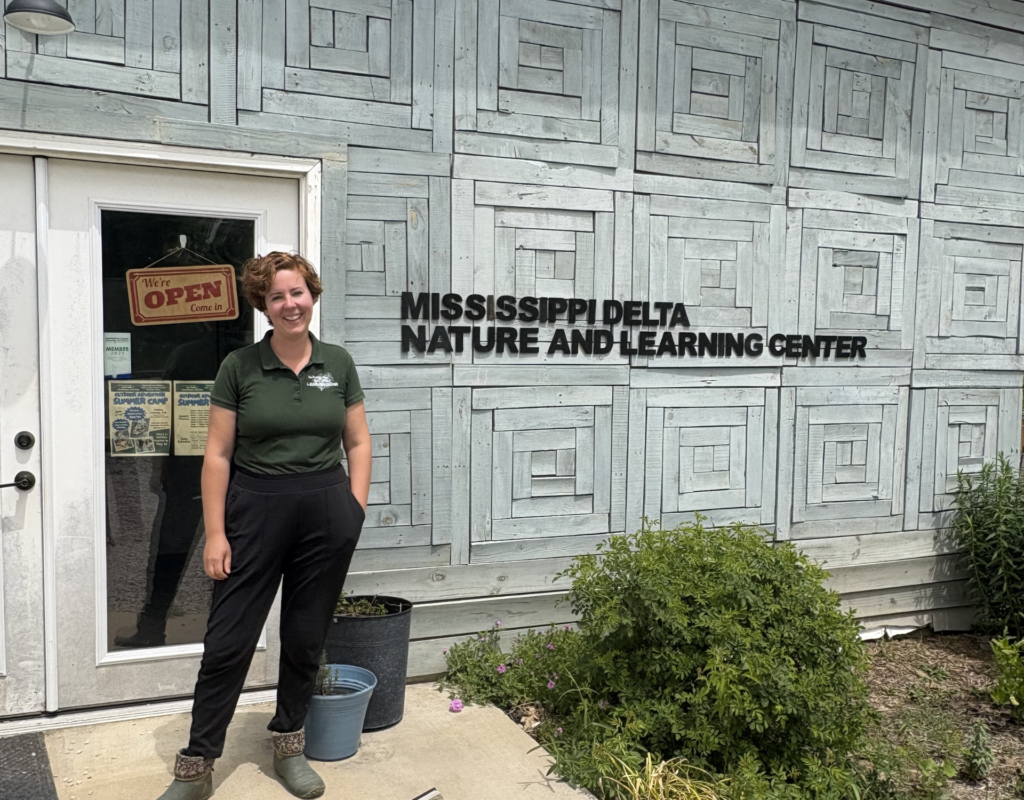
Originally from Utah, Amanda came to Mississippi through Teach for America and began her journey in education as an art teacher in Greenville. Over time, her passion for children, community, and meaningful learning experiences continued to grow. While working in schools, she began noticing something powerful: children often learned best when they were allowed to explore, create, observe, and engage with the world around them. When students stepped outside into gardens and nature-based learning spaces, they became more curious, more engaged, and more connected to learning itself.
That realization sparked a larger vision.
Amanda did not simply want to educate students inside a classroom. She wanted to help educate the community around them. She wanted children to understand science by experiencing it, families to reconnect with nature and one another, and young people in the Delta to see agriculture, environmental science, and entrepreneurship not just as subjects, but as opportunities.
The Mississippi Delta is rich in land, history, culture, and potential. Yet many children grow up seeing agriculture all around them without ever truly understanding the opportunities connected to it. Amanda recognized the need for a space that could reconnect young people to the land beneath their feet while also helping them discover purpose, creativity, critical thinking, and future career pathways through nature, science, and innovation.
So, she went to work.
In 2020, Amanda stood before city leaders with an idea to transform a neglected piece of land into a space for learning, growing, and community engagement. What many people saw as unusable land, Amanda saw as possibility. With the support of volunteers, community members, and service organizations, the vision slowly began to come to life. Pathways were built. Gardens were planted. Learning spaces were created. Families began visiting. Schools began scheduling field trips. Children began discovering a world beyond screens and worksheets.
What was once an overgrown property covered in poison ivy transformed into the Mississippi Delta Nature and Learning Center, a thriving educational and community-centered space where children, families, educators, and visitors come together to experience hands-on learning, agriculture, environmental awareness, entrepreneurship, and workforce development in real time. It is an example of what can happen when entrepreneurship meets purpose and community.
Families walk the trails together; children explore gardens and butterflies, and community members experience a space intentionally designed to bring people back together outdoors. Amanda shared stories of families reconnecting during simple moments at the center, from parents bonding with children while painting pumpkins to families using the space as neutral ground to spend meaningful time together.
The center also reflects a larger conversation Mississippi continues to have about workforce development and the future of education. In many ways, Amanda’s work mirrors the exact skills employers and communities across the country are searching for: critical thinking, creativity, adaptability, collaboration, and innovation. Amanda believes people should not only become consumers of information, but producers of ideas, solutions, and opportunities. She believes children and families thrive when they are encouraged to ask questions, solve problems, create, grow, and contribute meaningfully to their communities. And that is exactly what is being cultivated at the MS Delta Nature and Learning Center.
But perhaps one of the most important aspects of Amanda’s work is her focus on agriculture and entrepreneurship in the Delta.
Surrounded by farmland, Amanda noticed a disconnect. The Delta produces large-scale agricultural crops, yet many communities still struggle with access to fresh, locally grown food. She began envisioning a future where young people could once again see agriculture as an opportunity. Through youth agriculture programs and community-centered food initiatives, the center is now helping young people learn the basics of farming, food production, business ownership, and sustainability.
Her vision is not just about growing food. It is about growing confidence, leadership, and economic opportunities.
Amanda understands that entrepreneurship can feel overwhelming, especially in underserved communities. That is why she often encourages aspiring entrepreneurs to build strong teams, connect with their communities, ask questions, utilize available resources, and remain committed to their vision even when the work becomes difficult.
Amanda’s story is a reminder that innovation does not always begin inside a boardroom or a major corporation. Sometimes it begins with someone who simply notices a need, imagines a solution, jumps into action, and serves people in a meaningful way.
Sometimes it begins with a teacher.
Sometimes it begins with a garden.
And sometimes it begins with the courage to believe that transforming a community starts by helping people reconnect with curiosity, purpose, and one another.