School Choice in Mississippi: Options, Key Facts, and What the Data Shows
What Is School Choice?
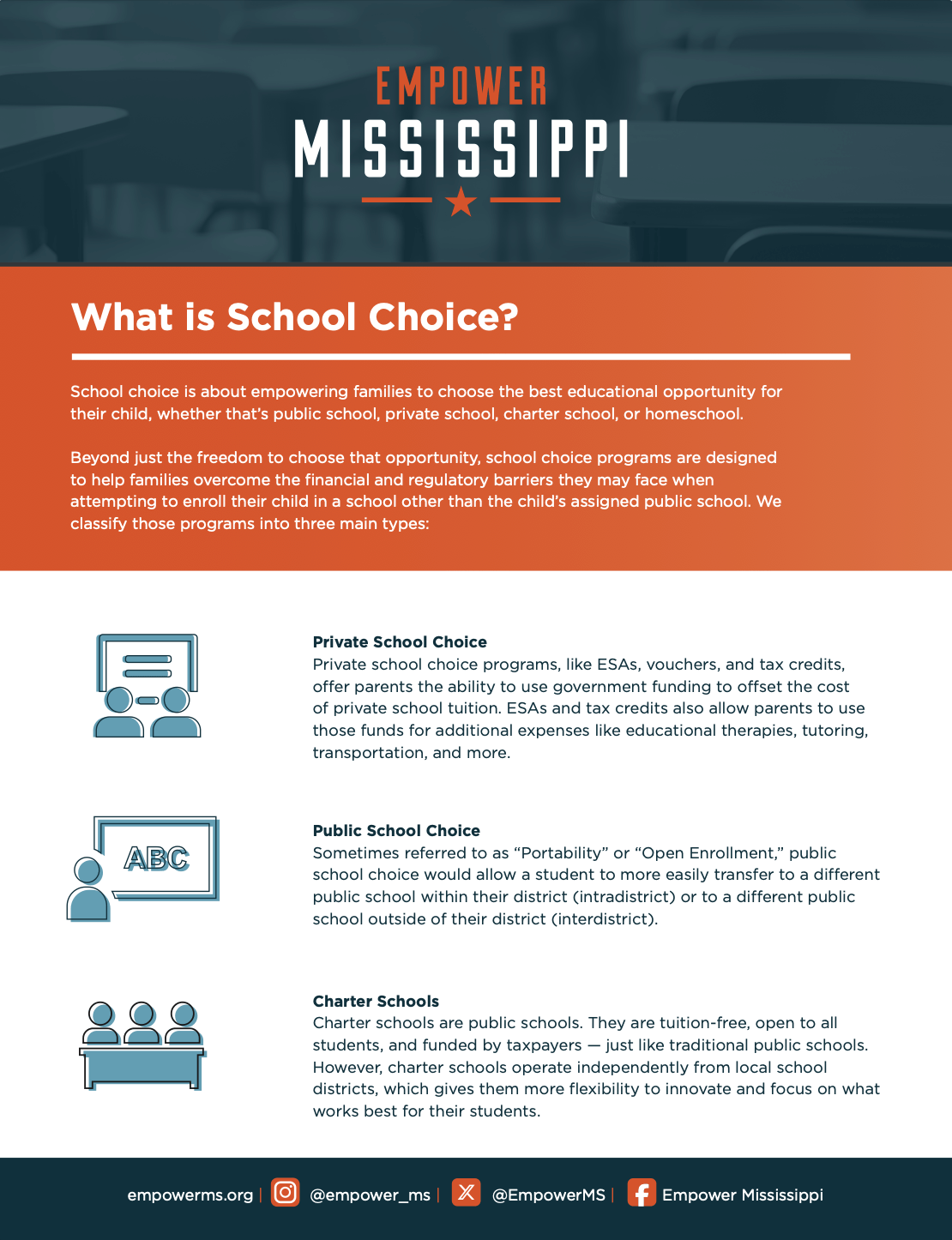
School choice, also known as education choice or “education freedom,” refers to policies that empower families to select the best K–12 educational setting for their child. This may include public schools, private schools, charter schools, or homeschooling. School choice programs are designed to remove financial and regulatory barriers, ensuring every child has access to an education that fits their needs.
Why School Choice Matters for Mississippi
-
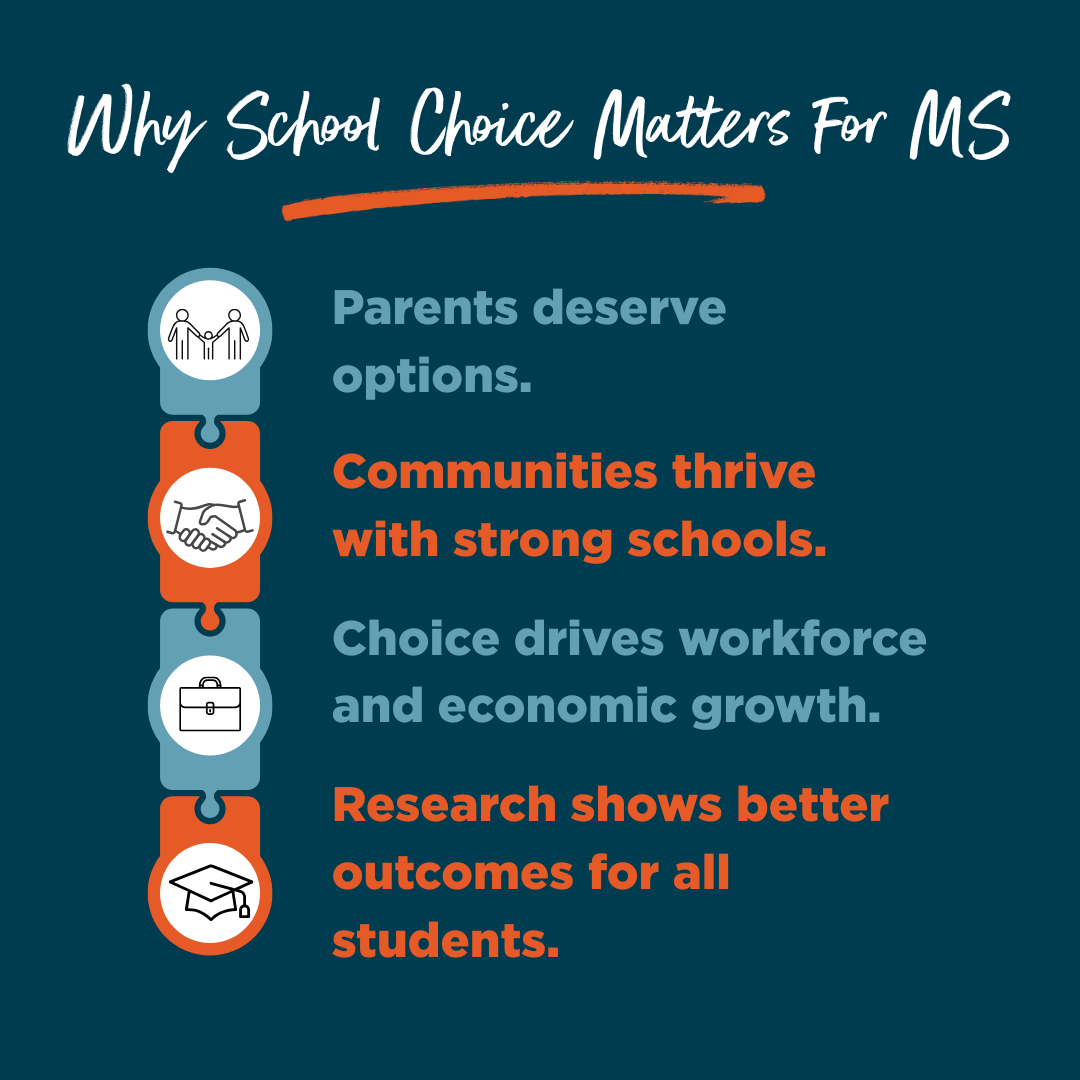
Parents know their children best and deserve meaningful options.
-
Communities grow stronger when families have access to quality schools.
-
A diverse education system supports workforce development and economic growth.
-
Research shows school choice improves outcomes for both participating students and those in traditional schools.
Types Of School Choice
Private Choice
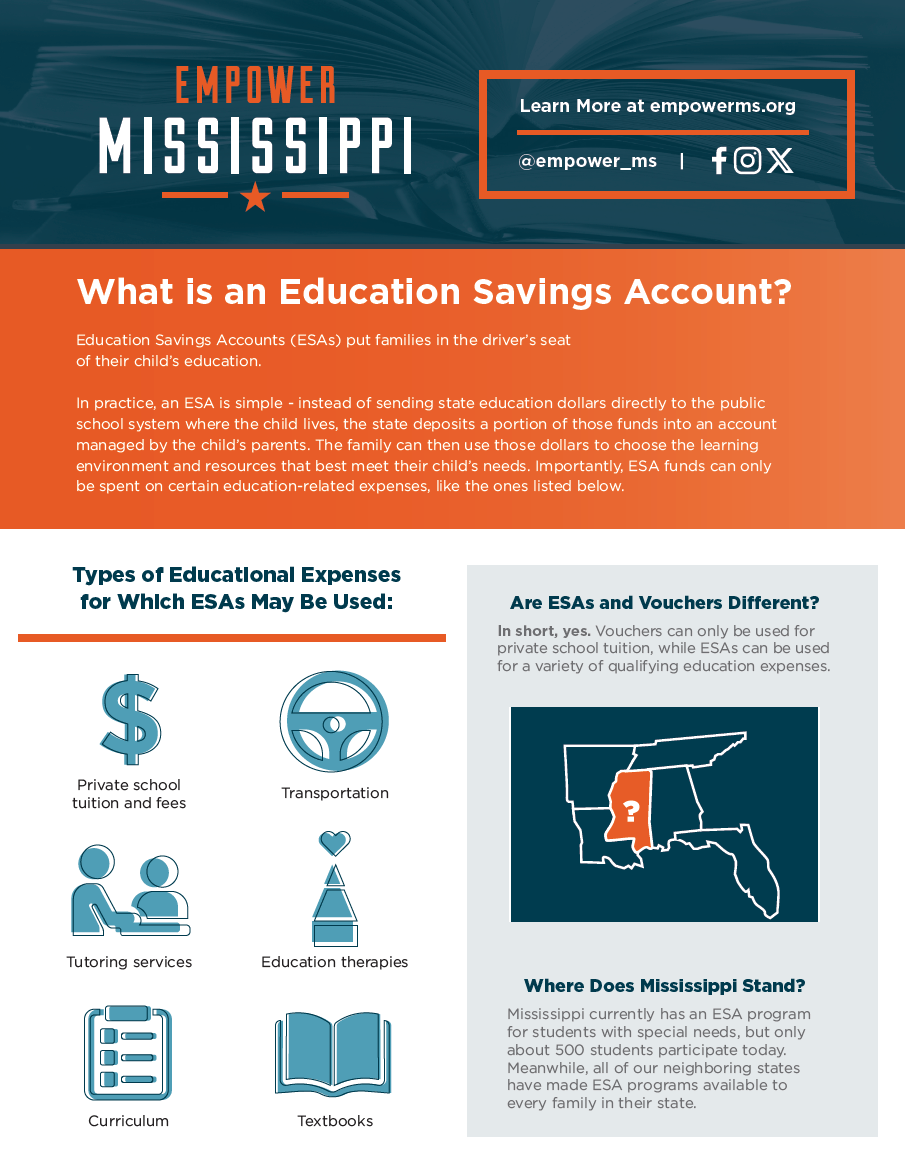
Programs like ESAs, vouchers, and tax credits help families afford private school tuition and can also cover tutoring, therapies, and other learning needs.
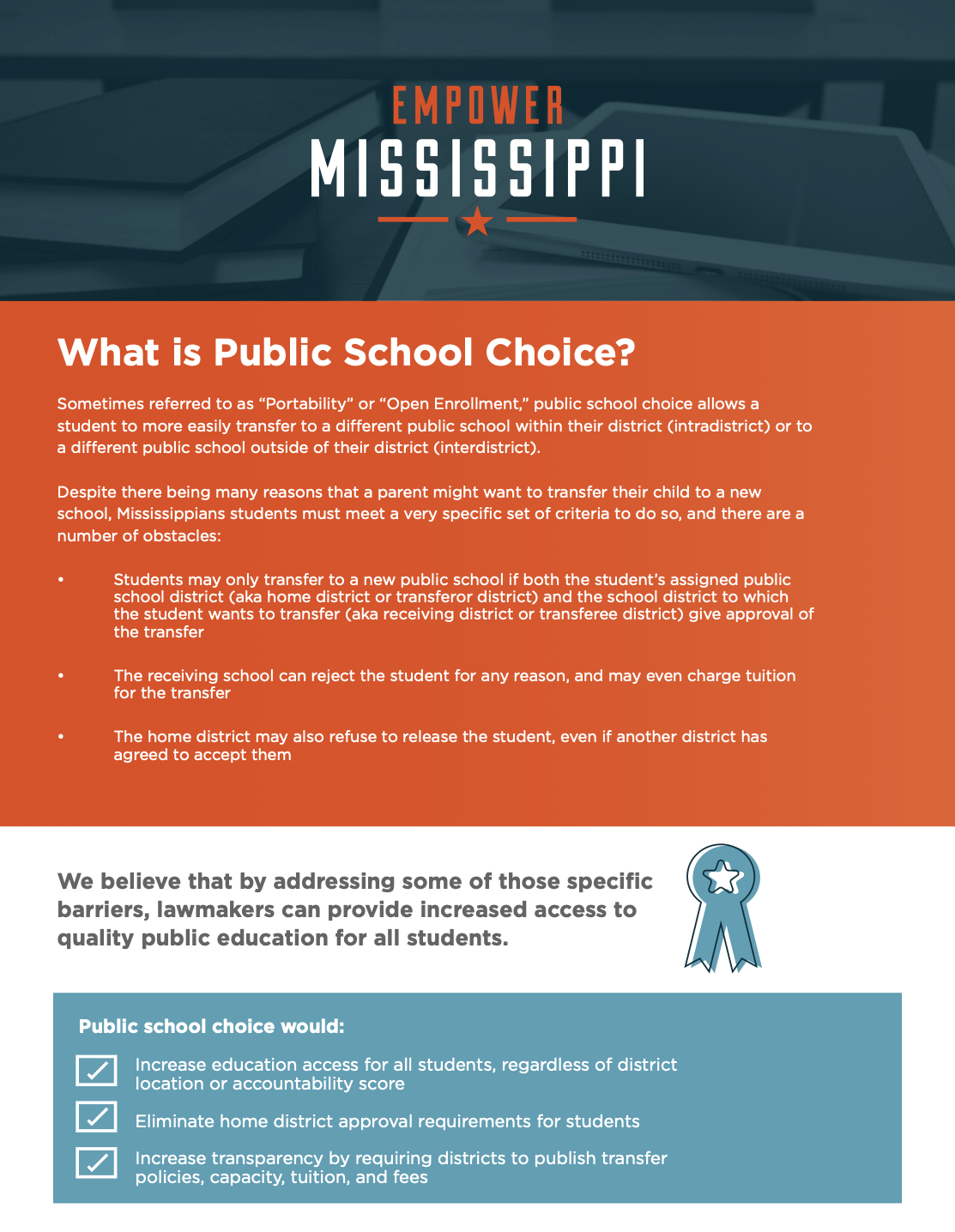
Public Choice (Open Enrollment)
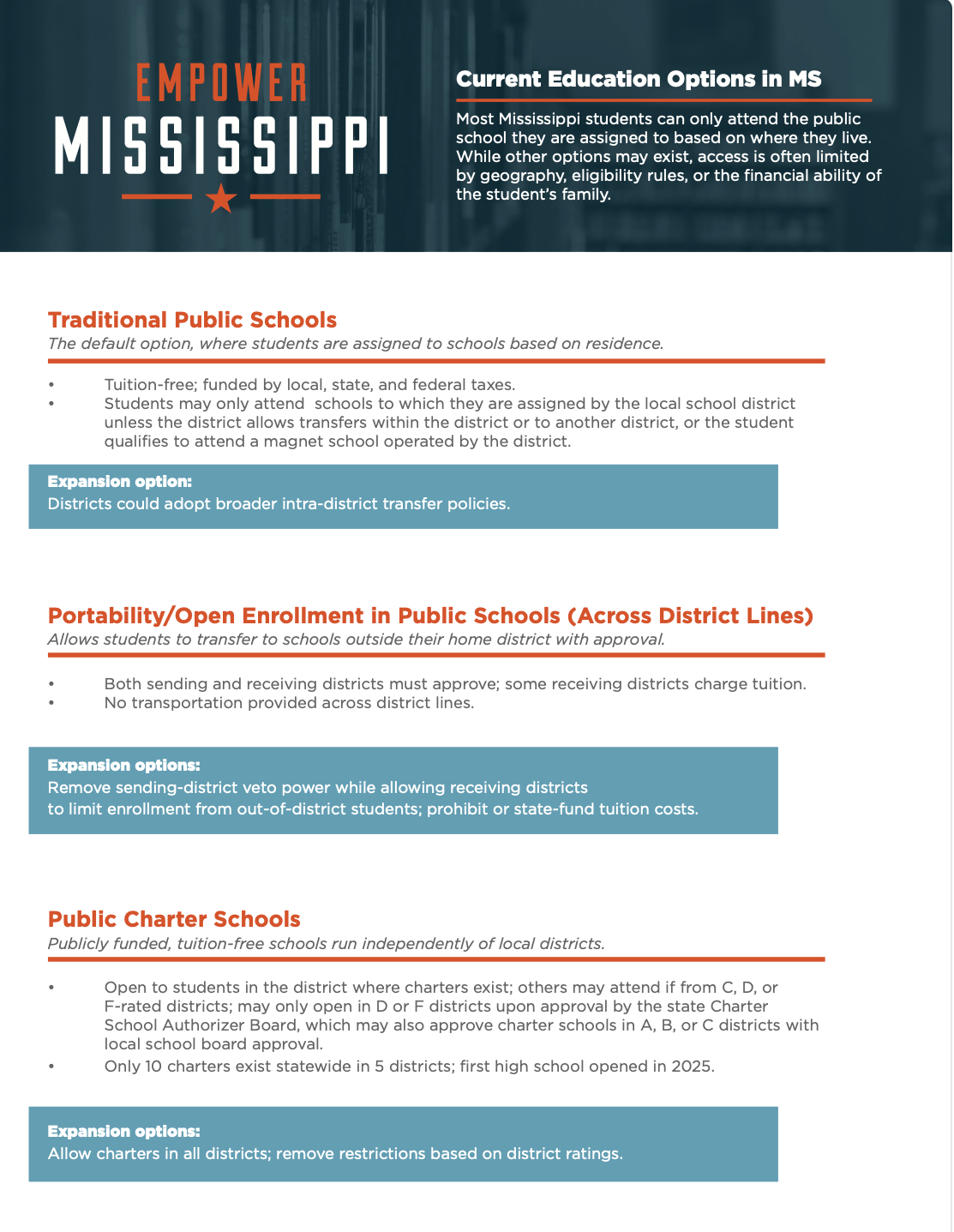
Lets students transfer within or outside their district, expanding access to quality public schools beyond their zip code.
Public Charter Schools
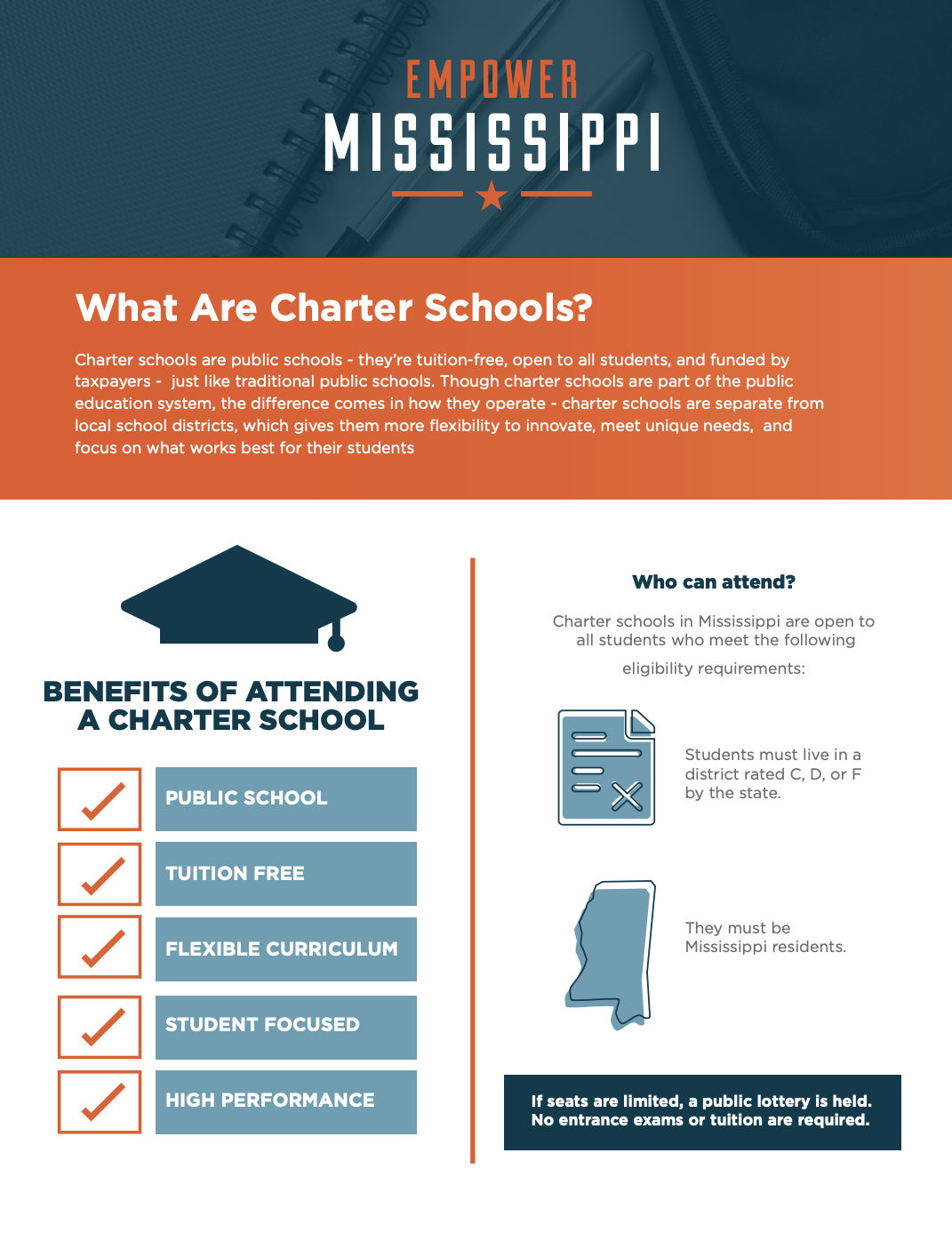
Tuition-free public schools, funded by taxpayers but independently run, are designed to innovate and focus on student success.
Overall MS Voter Support
Voter Support for School Choice in Mississippi
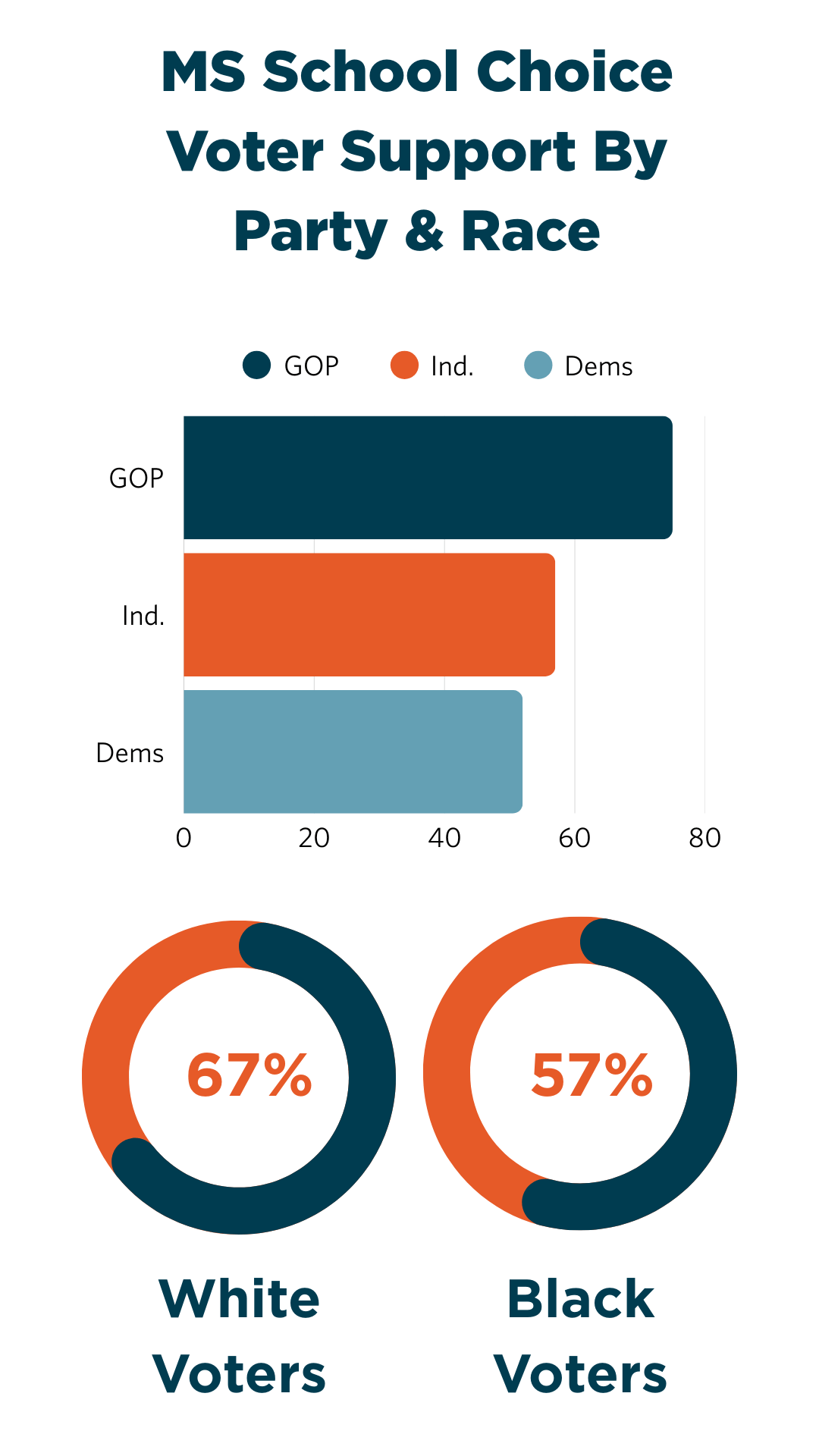
Recent polling of 600 registered voters shows strong support for school choice across party and racial lines.
-
Overall support: 64% of voters support school choice, 16% oppose.
-
By party: 75% of Republicans, 57% of Independents, 52% of Democrats support school choice.
-
By race: 67% of White voters, 57% of Black voters support school choice.
-
Impact on candidates: 74% of voters say a candidate’s support for school choice would either increase their likelihood to vote for them or make no difference; nearly half of GOP voters are more likely to support such candidates.
*Polling conducted in September 2025 by Empower Mississippi in partnership with Arc Insights*
School Choice Improves Student Performance
Competition from vouchers leads public schools to improve. Read Journal of Economic Literature Here
Private school choice benefits students who remain in public schools. Read Peabody Journal of Education Here
More education freedom is linked with higher NAEP scores and gains. Read Journal of School Choice Here
Nearly 30 peer-reviewed studies show private school choice raises test scores for students who stay in public schools.
Myth vs. Fact
Fact: Public school choice would not require any district to accept a student it doesn’t already have room for. It simply allows a district to accept students from other districts if it has available, unused seats. Taxpayers are already paying for those empty seats – this would simply allow those seats to be filled with students who want to be there, and for state funding to follow those students.
Fact: Again, public school choice would not require any district to accept a student it doesn’t already have room for. As a result, classroom sizes will not change. Further, transfer policies may be set by the receiving school district, thereby allowing for predictability.
Fact: Let’s be clear: “public money” comes from taxpayers and doesn’t belong to any school. And, as taxpayers, we should demand that our tax dollars be spent in a way that yields the best and highest returns. Research consistently shows that school choice improves outcomes for all students – both those who do and do not participate. Further, we know that when kids are well-educated, crime goes down, welfare dependence goes down, and employment and productivity go up. So, we believe giving every Mississippi family the ability to pursue the best education for their child is the highest and best use of “public dollars,” whether that’s in a public school, private school, homeschool, or charter school.
Using “public dollars” to pay private entities for the provision of public services is not a new concept. In fact, our government does it quite a lot. “Public dollars” have been used for decades to support students attending private colleges and universities. Private contractors are paid to build and maintain Mississippi’s roads and bridges. Medicaid and Medicare reimburse private doctors and hospitals for services rendered to recipients of those programs, and SNAP benefits can be used at privately owned and operated grocery stores.
Fact:
This hasn’t happened in other states. Reports from ExcelinEd and the Heritage Foundation both found that school choice did not cause private school tuition increases, and a report from Arizona shows that low- and middle-income children participate at high rates – “80% of ESA families may be low- and middle-income.”
Even if private schools did raise tuition, that would present an opportunity for public schools, charter schools, and other private schools to step in and provide more affordable alternatives. This is why we support all kinds of school choice – when families truly have options, the market will rise to meet demand.
Free market competition generally leads to lower prices and higher quality. We believe the same is true in education.
Fact: We estimate that the first-year cost of a universal private school choice program would be about $90 million, which is only about 3% of what the state spends on public school.
Fact:
In short, this is an inaccurate misrepresentation of data to support a political narrative. Evidence from 27 credible studies shows that school choice leads to improved outcomes for public school students. Even a study referenced by the Parents’ Campaign admits school choice benefits public school students:
“[The EdChoice Scholarships] modestly improved the achievement of the public-school students who were eligible for a voucher but did not use it. The competition associated with the introduction of EdChoice appears to have spurred these public-school improvements.”
This misleading claim doesn’t account for students entering kindergarten and those who were already participating in a school choice program prior to universal school choice, both of which make up a significant percentage of students whom opponents claim were “already in private schools.” Those students, essentially, represent no new cost to the state.
We also note that private school families currently save the state hundreds of millions of dollars a year by paying twice for education through both tuition and taxes. If those students were to move back to public school, the state would bear the cost.
That said, we estimate the first-year cost of a universal ESA program would be about $90 million, which is only about 3% of what the state spends on public schools and far less than critics suggest.
Our CEO, Grant Callen, recently explained why this is an inaccurate and misleading claim. It is also worth noting that states without school choice experienced dramatic declines in public school performance.
For example, New Jersey, New York, and Connecticut saw their average 4th-grade reading scores decline by 7, 9, and 11 points, respectively.
These three states also rank among the highest in the country for per-pupil public education spending.
While it's true that several school choice ballot measures have failed in recent elections in other states—often due to heavy opposition from teachers' unions and the complexities of ballot framing rather than outright rejection of the concept itself—the evidence paints a far different picture of broad, enthusiastic support among families. For example, more than half of Florida students attend a school other than their residentially assigned public school. Also, over 40,000 students applied for Tennessee’s school choice program in its first year. And polling consistently shows that Mississippi voters and Mississippi parents overwhelmingly support school choice.
Mississippi lawmakers have made historic investments in public schools. In fact, public school spending has increased roughly 12% per student over the last decade when adjusted for inflation. Our state spends almost $1 billion more on public education than it did just ten years ago, despite the number of public school students decreasing over the same period. Public schools are not underfunded, despite critics’ claims to the contrary.
Under school choice, public schools only lose money if a student chooses to go somewhere else. In that instance, the school has one less student to educate, just like if that student moved to another district. We would argue that public schools should not keep state funding for students they are not educating, just like they shouldn’t be able to hold families hostage based simply on where they live and how much money they make.
We believe the opposite is true: Mississippi public schools are not as accountable as private schools. Sure, public schools receive letter grades based on their performance, but we’ve seen that the state’s accountability model is broken. Further, many parents have no way to act on that information if they are dissatisfied – they are stuck with no other options.
Private schools, on the other hand, must be accountable to parents to keep students. If parents are not happy with the services they receive, they can go elsewhere. If enough students leave, the private school may be forced to close. The same is not true of public schools today.
We don’t believe private schools should be more like public schools – we want all schools to be accountable to parents and responsive to the needs of the children they serve. That’s true accountability – the system we have today is not.
Far from handing unchecked power to private schools, school choice flips the script by putting families firmly in the driver's seat, redirecting public funds to follow the student to the best-fit option, whether public, private, or charter. Private schools must compete for students and funding by meeting parents' standards; if they decline a child or underperform, they simply don't get the dollars—it's market accountability at work, not a blank check.
Make it make sense
The Mississippi Department of Education has released its public school accountability scores for the 2024-2025 school year.
This year’s grades exhibit continued signs of a broken “accountability” system:
- In one A-rated school district, only 39% of students are proficient in reading, and only 41% are proficient in math.
- In one B-rated school district, only 29% of students are proficient and reading, and only 37% are proficient in math
- One high school has a 95.5% graduation rate, but only 24% of students are proficient in reading. The district is graded B.
- In one school district, only 32% of students are proficient in reading. The district is graded B.
We deserve better. Our accountability system should transparently show how well public schools are doing. An A-rating should be a reflection of outstanding public school performance, and an A-rating for a district should mean all schools in the district are doing well.
Yet, in 10% of A-rated districts, less than half of students can read proficiently. In nearly every B-rated district, less than half of students are proficient in reading, and, in some, fewer than one in three students are reading proficiently. More than a few districts were given an A grade even though most of their schools are graded lower than an A, including as low as F!
Giving more than one-third of districts an A-rating, which the current accountability system does, and giving 92% of school districts a rating of A, B, or C, is the public education equivalent of a participation trophy.
Real accountability is more than reporting a letter grade, especially a misleading one. For parents, accountability is the power to walk away if they aren’t satisfied with the product or service they are receiving. Until every family in the state has that power, our public school accountability model will continue to be nothing more than a reporting tool – and a poor one at that.
Take Action