
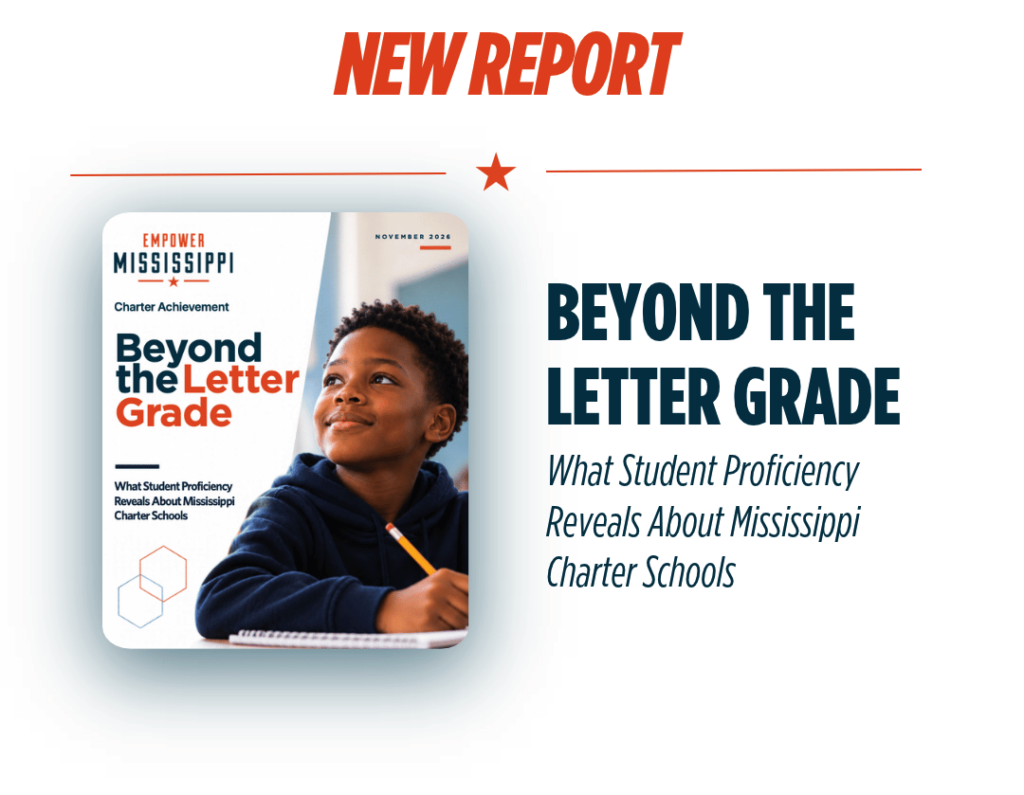
What Student Proficiency Reveals About Mississippi Charter Schools
Letter grades assigned to charter public schools based on state test results provide a snapshot of their performance. But they don’t tell the whole story about what students are learning or how a school compares with nearby traditional public schools that are run by the local district. Among other measures, we need to consider the district schools that charter students would otherwise attend if there were no charter schools.
Empower Mississippi analyzed school year 2025-26 state assessments and accountability data to compare charter schools and their students with schools run by the local school district and their students. Some of those results are published in our report, “Beyond the Letter Grade: What Student Proficiency Reveals about Mississippi Charter Schools.”
The most striking contrast is in Jackson, where four of the seven middle schools run by the Jackson Public School district (JPS) are graded F. One is graded D, and the other two only accept high-performing students, meaning middle school students who are struggling have very little chance at success if they don’t have a charter school available to them.
Empower also compared charter school students to their peers in the same grades and the same subjects in the schools run by the local school district.
In every one of the six charter middle schools in the state, students met grade-level standards at higher rates in sixth-, seventh-, and eighth-grade English language arts (ELA).
Almost all charters, including elementary schools, exceeded their district peers in every other grade level as well in ELA. Math performance was more mixed.
Key findings
There’s no question charter schools need to improve, but let’s look at the schools their students would have to attend if charters weren’t available to them.
- In Jackson, four of the five JPS-run middle schools that accept all students were graded F, and the fifth was graded D. In every English language arts (ELA) and math comparison for grades 6-8, a higher percentage of charter school students performed at or above grade level than their peers in JPS-run schools. Every district-run middle school in Jackson that is open to all students has fewer than 20% of their students who are proficient in reading and in math. None of the charter middle schools in Jackson have such a low percentage in either subject. Across tested grades 3-8, charter students also had higher overall proficiency rates in both subjects.
- Statewide, every Mississippi charter school except one had a higher percentage of students performing at or above grade level in ELA than district schools serving the same grades. Math results were more mixed. Charter schools tended to underperform local district peers in grades 3-5 math but compared more favorably in grades 6-8. This could be an indication that the longer students are in a charter school, the better they perform compared to their district peers.
- Mississippi has 126 D-graded or F-graded schools in districts graded A, B, or C. That means 31% of the schools in A, B, or C districts are graded D or F. Yet state law prohibits a new charter school from opening in any A, B, or C districts without local school board approval – which has never occurred in Mississippi. That means students in 126 schools have no opportunity for new charter schools to open in their district.
There is still substantial room for improvement. Most students in both the charter and district comparison groups remain below proficient.
What a letter grade doesn’t tell us
Empower Mississippi’s report, “Beyond the Letter Grade”, shows that a letter grade can be useful, but it cannot show how a school is performing in every grade and subject. And it doesn’t show how a charter school’s unique methods of providing an education can benefit individual students in line with their needs.
The report looks beyond letter grades by comparing charter students with their district peers in the same grades and subjects. Schools that admit only high-performing students are excluded from these comparisons.
The point is not that charter schools should be judged by a lower standard. They should continue improving and be held accountable for results.
The point is that families, policymakers and the public should have enough information to see what a single letter grade can miss. It gives families another way to understand how students are doing and to make informed decisions about where their children will be best served according to their needs. It also gives policymakers a broader perspective on the benefits of charter schools to the students and the communities they serve.
What does “proficient” mean?
A student is proficient when they meet or exceed Mississippi’s grade-level standard on the state assessment.
Looking at proficiency by grade and subject helps us compare how students are learning in the same community.
What this means for Mississippi
Charter schools are one public school option, not a solution for every student.
The report finds, however, that charter students — particularly in middle grades — are reaching proficiency at higher rates than their district peers.
At the same time, Mississippi limits where new charter schools can open. The report identifies 126 D-graded or F-graded schools within districts rated A, B or C, where a new charter requires local school board approval before it can be approved to open.
Mississippi should expect charter schools to improve and hold them accountable for results. But when charter schools are providing better opportunities for students, we should make it easier for more families to choose them.
About this research
“Beyond the Letter Grade: What Student Proficiency Reveals about Mississippi Charter Schools” was produced by Empower Mississippi.
For questions about the report, contact Forest Thigpen, Senior Advisor, at forest@empowerms.org.